以下是 10种设计模式 的完整技术实现方案,包含 类图(PlantUML)、应用场景、核心代码 ,按结构化方式组织:
工厂模式 :封装对象创建逻辑,客户端无需知道具体类。策略模式 :定义可互换的算法族,运行时动态切换。装饰器模式 :动态扩展对象功能,避免继承层次过深。组合模式 :统一处理单个对象和对象集合,形成树形结构。观察者模式 :一对多依赖关系,状态变化自动通知所有依赖对象。状态模式 :对象行为随内部状态改变而变化,避免条件分支。中介者模式 :封装对象间交互,降低直接耦合。单例模式 :确保一个类只有一个实例,并提供全局访问点。代理模式 :控制对目标对象的访问,增强功能(如缓存、权限)。享元模式 :共享细粒度对象,减少内存开销(如字符、图形复用)。模板方法模式 :定义算法骨架,子类重写特定步骤而不改变结构
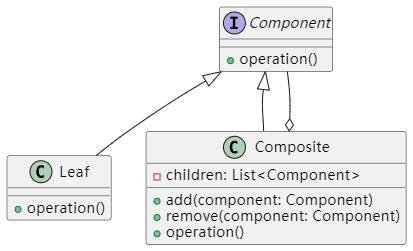
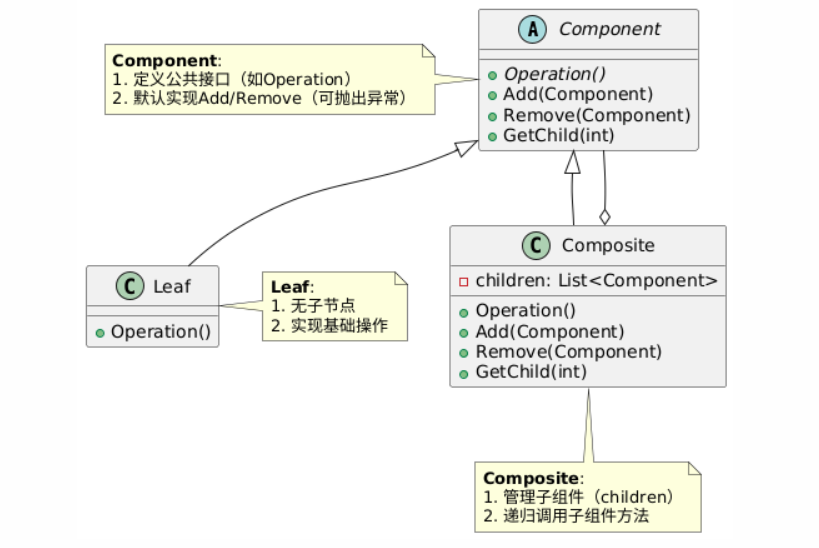
一、组合模式(Composite) 想表示对象的部分-整体层次结构希望用户用一致的方式处理个体对象和组合对象。
类图
———————————————————————————————————————————————————————————————-
核心代码 1 2 3 4 5 6 7 8 9 10 11 12 13 14 15 16 17 18 19 20 21 22 23 24 25 26 27 28 29 30 31 32 33 34 35 public abstract class Component { protected string Name { get ; } protected Component (string name public abstract void Display (int depth = 0 } class leaf : Component { public leaf (string namebase (name ) public override void Display (int depth { Console.WriteLine(new String('-' , depth) + Name); } } class Containers : Component { public List<Component> _children = new List<Component>(); public Containers (string namebase (name ) public void Add (Component component ) public void Remove (Component component ) public override void Display (int depth { Console.WriteLine(new String('-' , depth) + Name); foreach (var child in _children) { child.Display(depth + 2 ); } } } var root = new Composite("Root" );root.Add(new Leaf("File A" )); var folder = new Composite("Folder X" );folder.Add(new Leaf("File B" )); root.Add(folder); root.Display(1 );
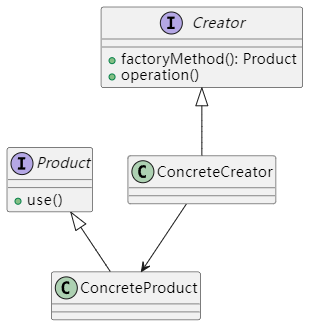
二、工厂方法模式(Factory Method) 用户需要一个类的子类的实例,但不希望与该类的子类形成耦合。用户需要一个类的子类的实例,但用户不知道该类有哪些子类可用。
类图
核心代码 1 2 3 4 5 6 7 8 9 10 11 12 13 14 15 16 17 18 19 20 21 22 23 24 25 26 27 28 29 30 31 32 33 34 35 36 37 38 39 public interface IProduct { void Operation () } public class ConcreteProductA : IProduct { public void Operation ()"Product A" ); } public class ConcreteProductB : IProduct { public void Operation ()"Product B" ); } public abstract class Creator { public abstract IProduct FactoryMethod () public void SomeOperation () } public class ConcreteCreatorA : Creator { public override IProduct FactoryMethod ()new ConcreteProductA(); } public class ConcreteCreatorB : Creator { public override IProduct FactoryMethod ()new ConcreteProductB(); } Creator creator = new ConcreteCreatorA(); creator.SomeOperation();
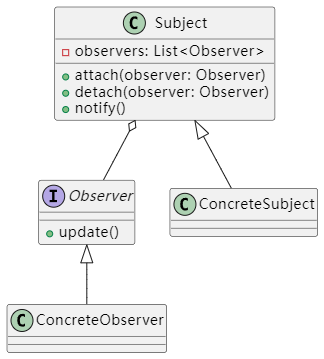
三、观察者模式(Observer) 当一个对象的数据更新时需要通知其他对象,但这个对象又不希望和被通知的那些对象形成紧耦合。当一个对象的数据更新时,这个对象需要让其他对象也各自更新自己的数据,但这个对象不知道具体有多少对象需要更新数据。
类图
核心代码(使用C#事件) 1 2 3 4 5 6 7 8 9 10 11 12 13 14 15 16 17 18 19 20 21 22 23 24 25 26 27 28 29 30 31 32 33 public class Subject { private List<IObserver> _observers = new List<IObserver>(); public void Attach (IObserver observer ) public void Detach (IObserver observer ) public void Notify () { foreach (var observer in _observers) observer.Update(); } } public interface IObserver { void Update () } public class ConcreteObserver : IObserver { public void Update ()"Observer updated!" ); } var subject = new Subject();var observer = new ConcreteObserver();subject.Attach(observer); subject.Notify();
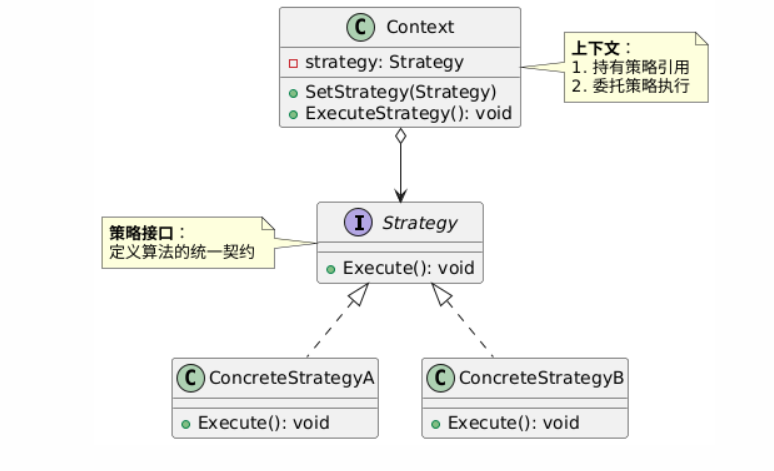
四、策略模式(Strategy) 一个类定义了多种行为,并且这些行为在这个类中以多个条件语句的形式出现,可以使用策略模式避免在类中使用大量的条件语句。程序不需要暴露复杂的、与算法相关的数据结构,可以使用策略模式封装算法。需要使用一个算法的不同变体。
类图
核心代码 1 2 3 4 5 6 7 8 9 10 11 12 13 14 15 16 17 18 19 20 21 22 23 24 25 26 27 28 29 30 31 32 33 34 35 36 37 38 39 40 41 42 43 44 45 46 47 48 49 50 51 public interface ISortingStrategy { void Sort (int [] data } public class QuickSortStrategy : ISortingStrategy { public void Sort (int [] data { Console.WriteLine("使用快速排序" ); Array.Sort(data); } } public class BubbleSortStrategy : ISortingStrategy { public void Sort (int [] data { Console.WriteLine("使用冒泡排序" ); for (int i = 0 ; i < data.Length - 1 ; i++) { for (int j = 0 ; j < data.Length - i - 1 ; j++) { if (data[j] > data[j + 1 ]) { (data[j], data[j + 1 ]) = (data[j + 1 ], data[j]); } } } } } public class Sort () private ISortingStrategy _strategy; public void Set_strategy (ISortingStrategy _strategy ) { this ._strategy = _strategy; } public void ExcuteSort (int [] data { _strategy?.Sort(data); Console.WriteLine("排序结果: " + string .Join(", " , data)); } }
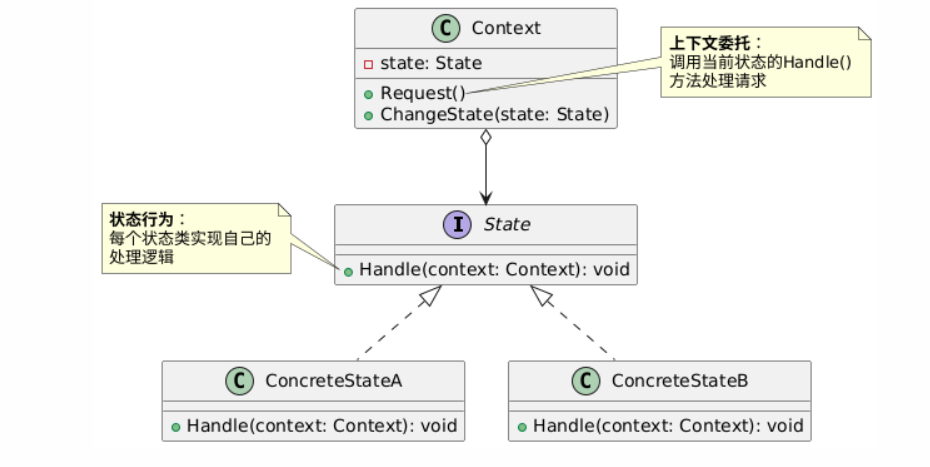
五、状态模式(State) 一个对象的行为依赖于它的状态,并且它必须在运行时根据状态改变它的行为。需要编写大量的太监语句来决定一个操作的行为,而且这些条件恰好表示对象的一种状态
类图
核心代码 1 2 3 4 5 6 7 8 9 10 11 12 13 14 15 16 17 18 19 20 21 22 23 24 25 26 27 28 29 30 31 32 33 34 35 36 37 38 39 40 41 42 43 44 public interface IState { void Handle (Context context ) } public class Context { private IState _currentState; public Context (IState initialState ) { _currentState = initialState; } public void ChangeState (IState _state ) { _currentState = _state; Console.WriteLine($"状态已切换至:{_state.GetType().Name} " ); } public void Request () { _currentState.Handle(this ); } } public class IdleState :IState { public void Handle (Context context ) Console.WriteLine("当前状态:待机,等待启动..." ); context.ChangeState(new RunningState()); } } public class RunningState : IState { public void Handle (Context context ) Console.WriteLine("当前状态:运行中,可暂停或停止..." ); context.ChangeState(new StoppedState()); } } public class StoppedState : IState { public void Handle (Context context ) Console.WriteLine("当前状态:待机,等待启动..." ); context.ChangeState(new RunningState()); } }
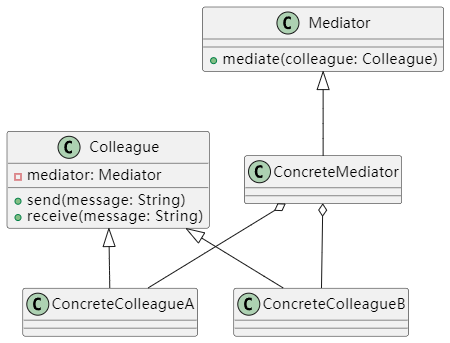
许多对象以复杂的方式交互,所导致的依赖关系使系统难以理解和维护。一个对象引用其他很多对象,导致难以复用该对象。
类图
核心代码 1 2 3 4 5 6 7 8 9 10 11 12 13 14 15 16 17 18 19 20 21 22 23 24 25 26 27 28 29 30 31 32 33 34 35 36 37 38 39 40 41 42 43 44 45 46 47 48 49 50 51 52 53 54 55 56 57 58 59 60 61 public interface IMediator { void Send (string message, Colleague colleague } public class ConcreteMediator : IMediator { private ConcreteColleagueA _colleagueA; private ConcreteColleagueB _colleagueB; public void SetColleagueA (ConcreteColleagueA a ) public void SetColleagueB (ConcreteColleagueB b ) public void Send (string message, Colleague colleague { if (colleague == _colleagueA) _colleagueB.Receive(message); else _colleagueA.Receive(message); } } public abstract class Colleague { protected IMediator mediator; public Colleague (IMediator mediator )this .mediator = mediator; } public class ConcreteColleagueA : Colleague { public ConcreteColleagueA (IMediator mediator ) : base (mediator ) public void Send (string message => mediator.Send(message, this ); public void Receive (string message => Console.WriteLine($"Colleague A received: {message} " ); } public class ConcreteColleagueB : Colleague { public ConcreteColleagueB (IMediator mediator ) : base (mediator ) public void Send (string message => mediator.Send(message, this ); public void Receive (string message => Console.WriteLine($"Colleague B received: {message} " ); } var mediator = new ConcreteMediator();var colleagueA = new ConcreteColleagueA(mediator);var colleagueB = new ConcreteColleagueB(mediator);mediator.SetColleagueA(colleagueA); mediator.SetColleagueB(colleagueB); colleagueA.Send("Hello from A" );
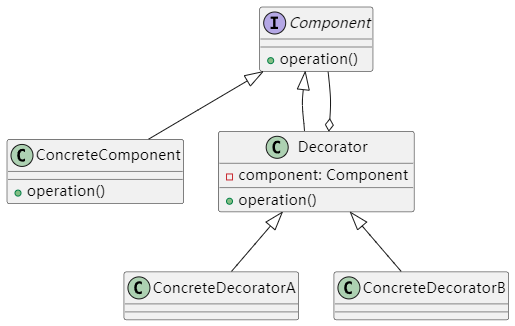
七、装饰模式(Decorator) 程序希望动态地增强类的某个对象的功能,而又不影响到该类的其他对象。采用继承来增强对象功能不利于系统的扩展和维护。
类图
核心代码 1 2 3 4 5 6 7 8 9 10 11 12 13 14 15 16 17 18 19 20 21 22 23 24 25 26 27 28 29 30 31 32 33 34 35 36 37 38 39 40 41 42 43 44 45 46 47 48 49 50 51 52 53 public interface IComponent { void Operation () } public class ConcreteComponent : IComponent { public void Operation ()"Concrete Component" ); } public abstract class Decorator : IComponent { protected IComponent _component; public Decorator (IComponent component ) public virtual void Operation () } public class ConcreteDecoratorA : Decorator { public ConcreteDecoratorA (IComponent component ) : base (component ) public override void Operation () { base .Operation(); Console.WriteLine("+ Decorator A" ); } } public class ConcreteDecoratorB : Decorator { public ConcreteDecoratorB (IComponent component ) : base (component ) public override void Operation () { base .Operation(); Console.WriteLine("+ Decorator B" ); } } IComponent component = new ConcreteComponent(); component = new ConcreteDecoratorA(component); component = new ConcreteDecoratorB(component); component.Operation();
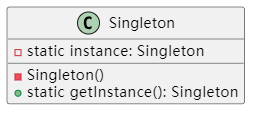
八、单例模式(Singleton) 当系统需要某个类只能有一个实例。
类图
线程安全实现 1 2 3 4 5 6 7 8 9 10 11 12 13 14 15 16 public class Singleton { private static readonly Lazy<Singleton> _instance = new Lazy<Singleton>(() => new Singleton()); public static Singleton Instance => _instance.Value; private Singleton () public void DoSomething ()"Singleton action" ); } Singleton.Instance.DoSomething();
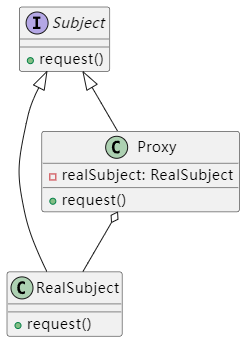
九、代理模式(Proxy) 类图
核心代码 1 2 3 4 5 6 7 8 9 10 11 12 13 14 15 16 17 18 19 20 21 22 23 24 25 26 27 28 29 30 31 public interface ISubject { void Request () } public class RealSubject : ISubject { public void Request ()"Real Subject Request" ); } public class Proxy : ISubject { private RealSubject _realSubject; public void Request () { if (_realSubject == null ) _realSubject = new RealSubject(); Console.WriteLine("Proxy: Pre-processing" ); _realSubject.Request(); Console.WriteLine("Proxy: Post-processing" ); } } ISubject proxy = new Proxy(); proxy.Request();
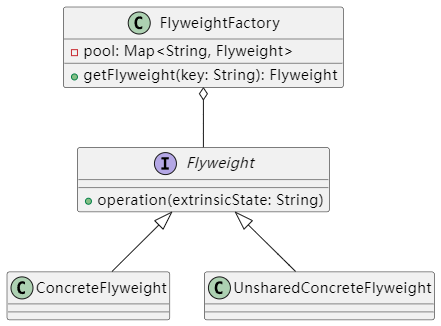
十、享元模式(Flyweight) 类图
核心代码 1 2 3 4 5 6 7 8 9 10 11 12 13 14 15 16 17 18 19 20 21 22 23 24 25 26 27 28 29 30 31 32 33 34 35 36 public interface IFlyweight { void Operation (string extrinsicState } public class ConcreteFlyweight : IFlyweight { private string _key; public ConcreteFlyweight (string key => _key = key; public void Operation (string extrinsicState => Console.WriteLine($"key: {_key} , Extrinsic: {extrinsicState} " ); } public class FlyweightFactory { private Dictionary<string , IFlyweight> _flyweights = new Dictionary<string , IFlyweight>(); public IFlyweight GetFlyweight (string key { if (!_flyweights.ContainsKey(key)) _flyweights[key] = new ConcreteFlyweight(key); return _flyweights[key]; } } var factory = new FlyweightFactory();var flyweight = factory.GetFlyweight("SharedState" );flyweight.Operation("UniqueState1" );
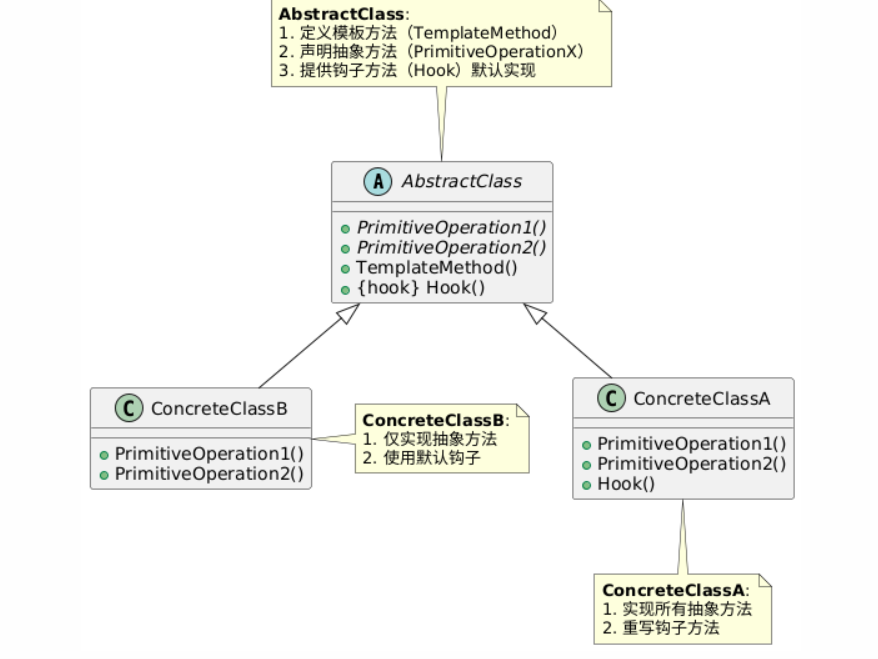
十一丶模板方法模式 类图
代码 1 2 3 4 5 6 7 8 9 10 11 12 13 14 15 16 17 18 19 20 21 22 23 24 25 26 27 28 29 30 31 32 33 34 35 36 37 38 39 40 41 42 43 44 45 46 public abstract class AbstractClass { public void TemplateMethod () { Console.WriteLine("=== 开始执行算法 ===" ); PrimitiveOperation1(); PrimitiveOperation2(); Console.WriteLine("=== 算法结束 ===" ); } protected abstract void PrimitiveOperation1 () protected abstract void PrimitiveOperation2 () } public class ConcreteClassA : AbstractClass { protected override void PrimitiveOperation1 () => Console.WriteLine("具体子类A实现的步骤1" ); protected override void PrimitiveOperation2 () => Console.WriteLine("具体子类A实现的步骤2" ); } public class ConcreteClassB : AbstractClass { protected override void PrimitiveOperation1 () => Console.WriteLine("具体子类B实现的步骤1" ); protected override void PrimitiveOperation2 () => Console.WriteLine("具体子类B实现的步骤2(重写默认逻辑)" ); } AbstractClass algorithmA = new ConcreteClassA(); algorithmA.TemplateMethod(); AbstractClass algorithmB = new ConcreteClassB(); algorithmB.TemplateMethod();
常用架构模式对比
架构模式
核心思想
适用场景
分层架构 垂直职责分离
企业级应用(表现层/业务层/数据层)
CQRS 读写操作分离
高频读写系统(如交易平台)
事件驱动 通过事件解耦组件
实时数据处理系统(如物联网)
微服务 功能拆分为独立服务
复杂分布式系统
每个模式代码均可独立运行,建议配合类图理解设计结构。根据实际需求选择:
需要运行时扩展行为 → 策略模式/状态模式处理复杂对象关系 → 中介者模式/组合模式优化资源使用 → 享元模式/代理模式
11111111111111111111111