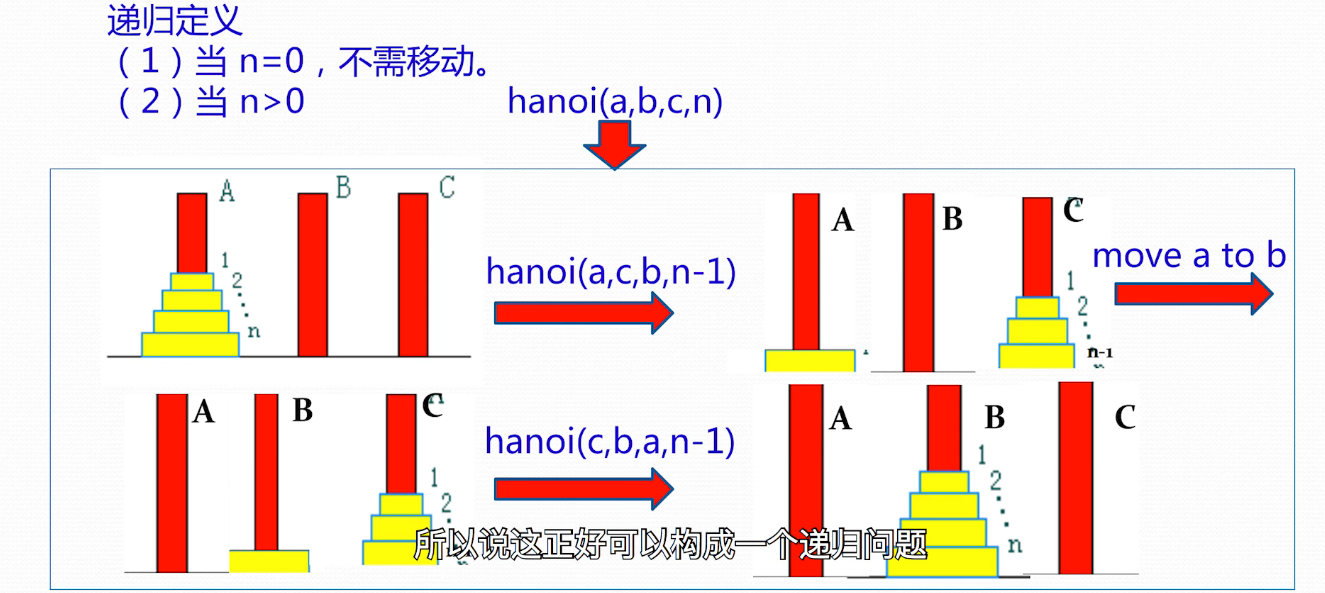
暴力递归 暴力递归的关键要素 一个典型的暴力递归算法包含三个要素:
1.递归终止条件: 定义问题最简单的情况,并直接返回结果。这是递归的出口,没有它会导致无限递归。
2.问题分解: 在每一步,将当前问题分解成一个或多个规模更小的同类型 子问题。
3.决策与尝试: 对于当前步骤,做出一个选择(或尝试所有可能的选择),然后基于这个选择递归地解决子问题,并将子问题的结果组合起来形成当前问题的解。
Hanoi塔问题 设a,b,c是3个塔座。要求由a移动到b。移动圆盘时遵守以下移动规则
1
2
3
4
5
6
7
8
9
10
11
12
13
14
15
public class Solution { public void Hanota (IList<int > A, IList<int > B, IList<int > C) Hanoi (A.Count,A,B,C); } public void Hanoi (int N,IList<int > form, IList<int > temp, IList<int > to) if (N == 1 ){ to.Add (form[0 ]); form.RemoveAt (0 ); return ; } Hanoi (N - 1 ,form,to,temp); Hanoi (1 ,form,temp,to); Hanoi (N - 1 ,temp,form,to); } }
字符串的全部子序列 思路:
首先将字符串转变为数组,创建一个空列表存储所有的子序列,同时初始化一个空字符串作为当前的子序列。
对于递归,首先找到BaseCase也就是递归中止条件,也就是下标索引等于字符串长度退出递归
如果当前索引 < 字符串长度:
需要当前索引处的元素:正在构建的子序列path + 当前索引的元素,处理下一个字符
不需要当前索引处的元素:path不变,处理下一个字符。
1
2
3
4
5
6
7
8
9
10
11
12
13
14
15
开始(path="") ├─ 不选'a' → path="" │ ├─ 不选'b' → path="" │ │ ├─ 不选'c' → 加入"" │ │ └─ 选'c' → 加入"c" │ └─ 选'b' → path="b" │ ├─ 不选'c' → 加入"b" │ └─ 选'c' → 加入"bc" └─ 选'a' → path="a" ├─ 不选'b' → path="a" │ ├─ 不选'c' → 加入"a" │ └─ 选'c' → 加入"ac" └─ 选'b' → path="ab" ├─ 不选'c' → 加入"ab" └─ 选'c' → 加入"abc"
1
2
3
4
5
6
7
8
9
10
11
12
13
14
15
16
17
18
19
20
21
22
23
24
25
26
27
static void Main (string [] args { List<string > list = new List<string >(); list = subs("abc" ); foreach (var i in list) { Console.WriteLine(i); } } public static List<string > subs (string str{ char [] arr = str.ToCharArray(); List<string > ans = new List<string >(); string path = "" ; process(arr, 0 , ans, path); return ans; } public static void process (char [] arr, int index, List<string > set , string path{ if (index == arr.Length) { set .Add(path); return ; } process(arr, index + 1 , set , path); process(arr, index + 1 , set , path + arr[index]); }
整型
1
2
3
4
5
6
7
8
9
10
11
12
13
14
15
16
17
18
19
public class Solution { public IList<IList<int >> Subsets(int [] nums) { var ans = new List<IList<int >>(); if (nums.Length == 0 ) return ans; List<int > path = new List<int >(); Process(nums,0 ,ans,path); return ans; } public void Process (int [] nums,int index,List<IList<int >> ans,List<int > path if (index == nums.Length){ ans.Add(path); return ; } Process(nums,index + 1 ,ans,path); var cur = new List<int >(path){nums[index]}; Process(nums,index + 1 ,ans,cur); } }
字符串的无重复子序列 在上述子序列的基础上使用HashSet即可,因为HashSet可以自动去重
1
2
3
4
5
6
7
8
9
10
11
12
13
14
15
16
17
18
19
20
21
22
23
24
25
26
27
28
29
30
31
32
static void Main (string [] args { HashSet<string > list = new HashSet<string >(); list = subs("acccc" ); foreach (var i in list) { Console.WriteLine(i); } } public static List<string > subs (string str{ char [] arr = str.ToCharArray(); List<string > ans = new List<string >(); HashSet<string > set = new HashSet<string >(); string path = "" ; process(arr, 0 , ans, path); foreach (var i in ans) { set .Add(i); } return ans; } public static void process (char [] arr, int index, List<string > set , string path{ if (index == arr.Length) { set .Add(path); return ; } process(arr, index + 1 , set , path); process(arr, index + 1 , set , path + arr[index]); }
字符串全排列 算法执行流程
1.初始化阶段 :
•将输入字符串转换为字符数组 arr。
•创建空列表 ans 存储所有排列结果。
•调用递归函数 process 开始生成排列。
2.递归函数 process :
•终止条件 :当 index 等于数组长度时,说明已经处理完所有字符,将当前排列(arr 的内容)加入结果列表 set。
•递归过程 :•从当前 index 开始,遍历后续所有字符(i 从 index 到 arr.Length - 1)。•交换字符 :将 arr[index] 和 arr[i] 交换位置(固定 index 位置的字符)。•递归调用 :处理下一个位置(index + 1)。•回溯 :恢复字符位置(交换回来),以便尝试其他排列组合。
字符串类型 1 2 3 4 5 6 7 8 9 10 11 12 13 14 15 16 17 18 19 20 21 22 23 24 25 26 27 28 29 30 31 32 33 34 35 36 37 38 39 40 41 42 43 44 45 static void Main (string [] args { List<string > list = new List<string >(); list = Permute("abc" ); foreach (var i in list) { Console.WriteLine(i); } Console.WriteLine("-----------------------------------------" ); } public static List<string > Permute (string str{ char [] arr = str.ToCharArray(); List<string > ans = new List<string >(); process(arr, 0 , ans); return ans; } public static void process (char [] arr, int index, List<string > set { if (index == arr.Length) { set .Add(new string (arr)); return ; } else { for (int i = index; i < arr.Length; i++) { Swap(arr, index, i); process(arr, index + 1 , set ); Swap(arr, index, i); } } } public static void Swap (char [] arr, int a, int b{ char temp = arr[a]; arr[a] = arr[b]; arr[b] = temp; }
整型 1 2 3 4 5 6 7 8 9 10 11 12 13 14 15 16 17 18 19 20 21 22 23 24 25 26 27 28 29 public class Solution { public IList<IList<int >> Permute(int [] nums) { var ans = new List<IList<int >>(); if (nums.Length == 0 ){ return ans; } process(nums,0 ,ans); return ans; } public void process (int [] nums,int index,IList<IList<int >> ans if (index == nums.Length) { List<int > current = new List<int >(nums); ans.Add(current); return ; }else { for (int i = index;i < nums.Length;i++){ Swap(nums,i,index); process(nums,index + 1 ,ans); Swap(nums,i,index); } } } public void Swap (int [] nums,int i,int j int temp = nums[i]; nums[i] = nums[j]; nums[j] = temp; } }
字符串无重复全排列 同样可以使用HashSet来去重。
1 2 3 4 5 6 7 8 9 10 11 12 13 14 15 16 17 18 19 20 21 22 23 24 25 26 27 28 29 30 31 32 33 34 35 36 37 38 using System;using System.Collections.Generic;public class Solution { public IList<IList<int >> Permute(int [] nums) { var ans = new List<IList<int >>(); if (nums.Length == 0 ) return ans; Process(nums, 0 , ans); return ans; } private void Process (int [] nums, int index, List<IList<int >> ans if (index == nums.Length) { ans.Add(new List<int >(nums)); return ; } var used = new HashSet<int >(); for (int i = index; i < nums.Length; i++) { if (!used.Contains(nums[i])) { used.Add(nums[i]); Swap(nums, i, index); Process(nums, index + 1 , ans); Swap(nums, i, index); } } } private void Swap (int [] nums, int i, int j if (i == j) return ; int temp = nums[i]; nums[i] = nums[j]; nums[j] = temp; } }
字符串
1 2 3 4 5 6 7 8 9 10 11 12 13 14 15 16 17 18 19 20 21 22 23 24 25 26 27 28 29 30 31 32 33 34 35 36 37 38 39 40 41 42 43 44 45 46 47 48 49 static void Main (string [] args { List<string > list = new List<string >(); list = Permute("abc" ); foreach (var i in list) { Console.WriteLine(i); } Console.WriteLine("-----------------------------------------" ); } public static List<string > Permute (string str{ char [] arr = str.ToCharArray(); List<string > ans = new List<string >(); process(arr, 0 , ans); return ans; } public static void process (char [] arr, int index, List<string > set { if (index == arr.Length) { set .Add(new string (arr)); return ; } else { bool [] T = new bool [256 ]; for (int i = index; i < arr.Length; i++) { if (!T[nums[i]]){ T[nums[i]] = true ; Swap(arr, index, i); process(arr, index + 1 , set ); Swap(arr, index, i); } } } } public static void Swap (char [] arr, int a, int b{ char temp = arr[a]; arr[a] = arr[b]; arr[b] = temp; }
栈逆序 在不申请其他数据结构的前提下,将栈逆序
取出栈底元素 (f函数):
•递归弹出栈顶元素,直到栈为空时返回最底部的元素。
•在递归返回过程中,将非栈底元素重新压回栈中,从而保留栈的原始顺序(仅移除栈底元素)。
逆序整个栈 (Reserve函数):
•每次递归调用 f 获取当前栈的最底层元素 ,然后对剩余栈继续递归逆序。
•递归到底层(栈空)后,开始将之前取出的栈底元素依次压回栈顶,最终实现整体逆序。
本质 :通过递归隐式暂存栈底元素,利用系统调用栈模拟“反向压入”的过程,无需显式辅助栈。时间复杂度为 O(n²),空间复杂度 O(n)(递归栈深度)。
1 2 3 4 5 6 7 8 9 10 11 12 13 14 15 16 17 18 19 20 21 22 23 24 25 26 27 28 29 30 31 32 33 34 35 36 37 38 39 public static void Reserve (Stack<int > stack ) if (stack.Count == 0 ) return ; int last = GetBottomElement(stack); Reserve(stack); stack.Push(last); } public static int GetBottomElement (Stack<int > stack ){ int result = stack.Pop(); if (stack.Count == 0 ) { return result; } else { int realBottom = GetBottomElement(stack); stack.Push(result); return realBottom; } }
动态规划 动态规划基本步骤
找出最优解的性质,并刻划其结构特征(最优子结构性质)
递归地定义最优值。
以自底向上的方式计算出最优值。
根据计算最优值时得到的信息,构造最优解
例题1:机器人线性走路
机器人在1到N的直线上移动:
•在位置1时,只能向右移动到位置2
•在位置N时,只能向左移动到位置N-1
•在中间位置i(1 < i < N)时,可以向左移动到i-1或向右移动到i+1
问题 :从起点S走到终点E有多少种不同的路径?
机器人在一条长度为 N的直线上移动,从起点 Start出发,经过恰好 K 步后到达终点 Aim,求所有可能的路径数。
1. 问题分析
•机器人的移动规则 :•如果当前在位置 1 ,下一步只能向右走到 2 。•如果当前在位置 N ,下一步只能向左走到 N-1 。•如果当前在中间位置 i (1<i <N ),可以向左走到 i −1 或向右走到 i +1。
•目标 :计算从 Sta r**t 出发,恰好走 *K* 步 到达 A**im 的所有路径数。
1 2 3 4 5 6 7 8 9 10 11 12 13 14 15 16 17 18 19 20 21 22 23 24 25 26 27 28 29 30 31 32 33 34 35 36 37 38 39 40 41 42 43 44 public static int Ways (int N, int Start, int Aim, int K{ int [][] dp = new int [N + 1 ][]; for (int i = 0 ; i <= N; i++) { dp[i] = new int [K + 1 ]; for (int j = 0 ; j <= K; j++) { dp[i][j] = -1 ; } } return Process(N, Start, Aim, K, dp); } public static int Process (int N, int cur, int aim, int rest, int [][] dp{ if (dp[cur][rest] != -1 ) { return dp[cur][rest]; } int ans = 0 ; if (rest == 0 ) { ans = (cur == aim) ? 1 : 0 ; } else if (cur == 1 ) { ans = Process(N, 2 , aim, rest - 1 , dp); } else if (cur == N) { ans = Process(N, N - 1 , aim, rest - 1 , dp); } else { ans = Process(N, cur - 1 , aim, rest - 1 , dp) + Process(N, cur + 1 , aim, rest - 1 , dp); } dp[cur][rest] = ans; return ans; }
例题2:博弈游戏最优策略
给定一个整型数组arr,代表数值不同的纸牌拍成一条线,玩家A和玩家B依此拿走每张纸牌,规定玩家A先拿,玩家B后拿,但是每个玩家每次只能拿着最左或最右的纸牌,请返回最后的获胜者的分数
方法1 :暴力递归:
Win函数 :
主函数,处理边界情况(空数组或null)
计算先手玩家和后手玩家的最佳得分,返回两者中的最大值
f函数(先手函数) :
表示当前玩家作为先手时能获得的最大分数
基本情况:当L == R时,只有一个数字,直接取走
递归情况:
p1:取左边数字 + 作为后手在剩余数组中的得分
p2:取右边数字 + 作为后手在剩余数组中的得分
返回两者中的最大值(因为先手会选择对自己最有利的方案)
g函数(后手函数) :
表示当前玩家作为后手时能获得的分数
基本情况:当L == R时,先手已取走唯一数字,后手得0
递归情况:
p1:先手取走左边数字后,自己作为先手在剩余数组中的得分
p2:先手取走右边数字后,自己作为先手在剩余数组中的得分
返回两者中的最小值(因为对手会留下对自己最不利的局面)
1 2 3 4 5 6 7 8 9 10 11 12 13 14 15 16 17 18 19 20 21 22 23 24 public static int Win (int [] arr { if (arr == null ||arr.Length == 0 ) return 0 ; int first = f(arr, 0 , arr.Length - 1 ); int Second = g(arr, 0 , arr.Length - 1 ); return Math.Max(first,Second); } public static int f (int [] arr,int L,int R { if (L == R) return arr[L]; int p1 = arr[L] + g(arr,L + 1 ,R); int p2 = arr[R] + g(arr, L, R - 1 ); return Math.Max(p1, p2); } public static int g (int [] arr,int L,int R { if (L == R) return 0 ; int p1 = f(arr,L + 1 ,R); int p2 = f(arr,L,R - 1 ); return Math.Min(p1, p2); }
动态规划:记忆化搜索,添加2个数组用于记录已经出现的数
1 2 3 4 5 6 7 8 9 10 11 12 13 14 15 16 17 18 19 20 21 22 23 24 25 26 27 28 29 30 31 32 33 34 35 36 37 38 39 40 41 42 43 44 45 46 47 48 49 50 51 52 53 54 55 56 57 58 public static int Win (int [] arr{ if (arr == null ||arr.Length == 0 ) return 0 ; int [][] gmap = new int [arr.Length][]; int [][] fmap = new int [arr.Length][]; for (int i = 0 ; i < arr.Length;i++) { gmap[i] = new int [arr.Length]; fmap[i] = new int [arr.Length]; for (int j = 0 ; j < arr.Length; j++) { gmap[i][j] = -1 ; fmap[i][j] = -1 ; } } int first = f(arr, 0 , arr.Length - 1 ,gmap,fmap); int Second = g(arr, 0 , arr.Length - 1 , gmap, fmap); return Math.Max(first,Second); } public static int f (int [] arr,int L,int R, int [][] gmap, int [][]fmap{ if (fmap[L][R] != -1 ) return fmap[L][R]; int ans = 0 ; if (L == R) { ans = arr[L]; } else { int p1 = arr[L] + g(arr, L + 1 , R,gmap,fmap); int p2 = arr[R] + g(arr, L, R - 1 , gmap, fmap); ans = Math.Max(p1, p2); } fmap[L][R] = ans; return ans; } public static int g (int [] arr,int L,int R, int [][] gmap, int [][] fmap{ if (gmap[L][R] != -1 ) return fmap[L][R]; int ans = 0 ; if (L == R) { ans = 0 ; } else { int p1 = f(arr,L + 1 ,R, gmap, fmap); int p2 = f(arr, L, R - 1 , gmap, fmap); ans = Math.Min(p1, p2); } gmap[L][R] = ans; return ans; }
例题3:背包问题
背包容量 W
N个物品,每个物品有重量 w[i]和价值 v[i]目标 :在不超过背包容量的情况下,最大化总价值
1 2 3 4 5 6 7 8 9 10 11 12 13 14 15 16 17 18 19 20 21 22 23 24 25 public static int MaxValue (int [] w, int [] v, int bag{ if (w == null || v == null || w.Length != v.Length || bag <= 0 ) return 0 ; return Process(w, v, 0 , bag); } public static int Process (int [] w, int [] v, int index, int bag{ if (bag < 0 ) return -1 ; if (index == w.Length) return 0 ; int p1 = Process(w, v, index + 1 , bag); int p2 = 0 ; int next = Process(w, v, index + 1 , bag - w[index]); if (next != -1 ) p2 = v[index] + next; return Math.Max(p1, p2); }
例题
给定一个仅包含数字 '0'-'9'的字符串 str,假设 'A' = 1, 'B' = 2, ..., 'Z' = 26,问有多少种方式可以解码这个字符串?
示例
"12"→ "AB" (1 2)或 "L" (12)→ 2 种 "226"→ "BZ" (2 26)、"VF" (22 6)、"BBF" (2 2 6)→ 3 种 "06"→ "0"无法解码 → 0 种
基本情况 :
•如果 index到达字符串末尾,返回 1(表示找到一种解码方式)。
•如果当前字符是 '0',返回 0('0'不能单独解码)。
递归计算 :
•单字符解码 :process(str, index + 1)(当前字符单独解码)。
•双字符解码 :如果 index + 1未越界,且 str[index]和 str[index + 1]组成的数字 <= 26,则 ways += process(str, index + 2)。
1
2
3
4
5
6
7
8
9
10
11
12
13
14
15
16
17
18
public static int number (string str{ if (str == null ||str.Length == 0 ) return 0 ; return process(str.ToCharArray(),0 ); } public static int process (char [] str,int index{ if (index == str.Length) return 1 ; if (str[index] == '0' ) return 0 ; int ways = process(str, index + 1 ); if (index + 1 < str.Length && (str[index] - '0' ) * 10 + str[index + 1 ] - '0' < 27 ) ways += process(str, index + 2 ); return ways; }
**例题4:**给定一个字符串str,给定一个字符串类型的数组arr,出现的字符都是小写英文arr每一个字符串,代表一张贴纸,你可以把单字
符剪开使用,目的是拼出str来返回需要至少多少张贴纸可以完成这个任务。
例子: str= “babac”, arr ={“ba”,”c”,”abcd”}至少需要两张贴纸”ba”和”abcd”,因为使用这两张贴纸,把每一个字符单独剪开,含有2个a、2
个b、1个c。是可以拼出str的。所以返回2。
例题5 :给定一个字符串str,返回这个字符串的最长回文子序列长度
比如:str=“a12b3c43def2ghi1kpm”,最长回文子序列是“1234321”或者“123c321”,返回长度7